CURRENCY VALUATION
Perhaps one of the greatest differences between macro- and micronational currencies is the actual value they claim to possess - often assessed based on their extent of circulation as well as their convertibility into hard currencies (or sometimes previous metals). Unlike regular currencies, few micronational currencies ever pretend to be a formal, legal tender medium of exchange - Rather, they often serve for symbolic purposes only. That is, they are often created to be proof of micronational sovereignty, whereas physical forms of currency (coins or banknotes), should they ever be minted, also tend to be kept within the micronational territory or sold solely as void souvenirs. While some micronational currencies may claim to have a nominal value, it often functions more as an arbitrary price tag for collectors rather than an indicator of freely exchangeable currencies based on their actual monetary value.
In this brief article, I shall categorize and examine physical currencies issued by micronations based on the aforementioned criteria, namely whether they are used in local circulation as an acceptable medium of exchange, and whether they can be freely exchanged for hard currencies and precious metals. In the end, we see four different tiers of micronational currencies: I) circulating and convertible, II) circulating but non-convertible, III) non-circulating but convertible, and finally IV) neither circulating nor convertible. Any information gathered on their status of circulation and their convertibility is based on existing accounts reported prior to the completion of this analysis so as to ensure its correctness and neutrality.
I. Circulating, convertible
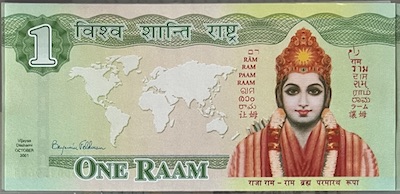
Raam of the Global Country of World Peace (GCP1)
While such cases are extremely scarce, some micronations do claim their currencies to be both in active circulation (albeit to a much less extent) and, at the same time, convertible to legal tender currencies. These currencies are often referred to by those outside micronationalism as community currencies, as they tend to circulate within a relatively small area (often a village or a town inhabitated mostly by the participants of the micronation), where at least some of the residents are willing to accept them as a complementary form of payment. Perhaps one of the most famous examples among them is the Raam issued by the Global Country of World Peace. Nominally a bearer bond, it functions as a de facto community currency in some parts of Vlodrop, Netherlands and Fairfield, US, where it claims to be accepted by the GCWP-affiliated institutions as well as a number of local merchants. Depending on its place of issue, the Raam is also said to be fully convertible to Euro, US$, or CAD at a constant rate of 1:10. Another confirmed example of Tier I currencies is the Credito issued by the Federation of Damanhur near Pramarzo, Italy - circulating among members of this small spiritual community for decades and purportedly able to be converted back to Italian lire and later the Euro.
II. Circulating, non-convertible
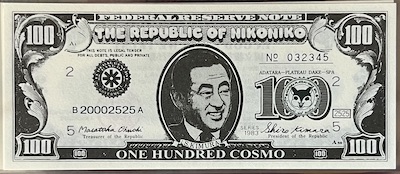
Cosmo of the Republic of Niko Niko (NIK1)
Compared to Tier I currencies, Tier II currencies are relatively more common - Many micronations, especially those intending to be tourist attractions, tend to issue their currencies as de facto vouchers, which can be used by visitors to purchase gifts and souvenirs at authorized stores. However, these vouchers differ from community currencies, since despite any nominal value they claim to possess, they are not really convertible to legal tender currencies once they have been bought by tourists. In some cases, no change (at least not in legal tender currencies) is given if visitors decide to spend these vouchers on-site - for instance the Cosmo issued by the Republic of Niko Niko in Nihonmatsu, Japan, which in reality functions as a 100-Yen coupon for use at several local restaurants, hotels, etc. Many Tier II currencies also have a clearly stated expiry date, which further limits the validity of these vouchers - such as the De l'art de L'Anse issued by the Kingdom of L'Anse Saint-Jean near Saguenay, Canada, which was only valid for a brief period from its general distribution in 1998 toward the end of 1999.
III. Non-circulating, convertible
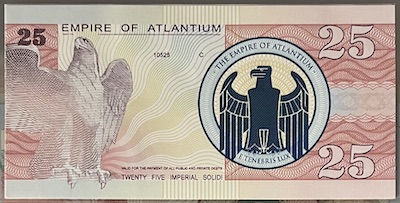
Imperial Solidus of the Empire of Atlantium (ATL2)
Despite initial expectations, the physical size of many micronations has hindered their currencies from actually being able to circulate. For these micronations - especially those claiming only a house or an even smaller piece of territory, it is often the case that their currencies only serve as a de jure symbol of their sovereignty and independence instead of a serious medium of exchange. Nonetheless, it is not rare that some of these micronations are also willing to take responsibility for their nominal currencies, hence allowing them to be convertible to at least one legal tender currency depending on the capability of their financial reserves. Examples of such Tier III currencies include, for example, the Imperial Solidus issued by the Empire of Atlantium in Sydney, Australia, and the Hesperian dollar issued by the Empire of Hesperia in Alameda, US, with both micronations ensuring the possessors of their currencies that they can exchange them to US$ freely at any time, provided that they return the banknotes at their own expense (and for an additional fee of $5 in the latter case).
IV. Non-circulating, non-convertible
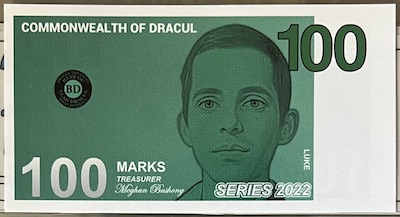
Mark of the Commonwealth of Dracul (DRA45)
Corresponding with popular beliefs, Tier IV currencies resemble simple souvenirs of no monetary value whatsoever. In the field of philately, these items are also known as cinderellas - Although they are seldom regarded as serious collectibles, they do attract the attention of some collectors, often because of their professional designs or printing techniques. Compared to other micronational currencies, they are often being sold directly by their producers at a significantly lower price, as they neither pretend nor intend to be real currencies - hence not convertible to any legal tender currencies, either. Famous examples of Tier IV currencies include the Draculian Mark issued by the Commonwealth of Dracul in Houston, US, and the Oriental Lira issued by the Oriental People's Socialist Republic in Davao, Philippines, with both micronations clearly marking their banknotes as pure novelty items.
Copyright © 2011-2026 Y. D. Zhang. All Rights Reserved.